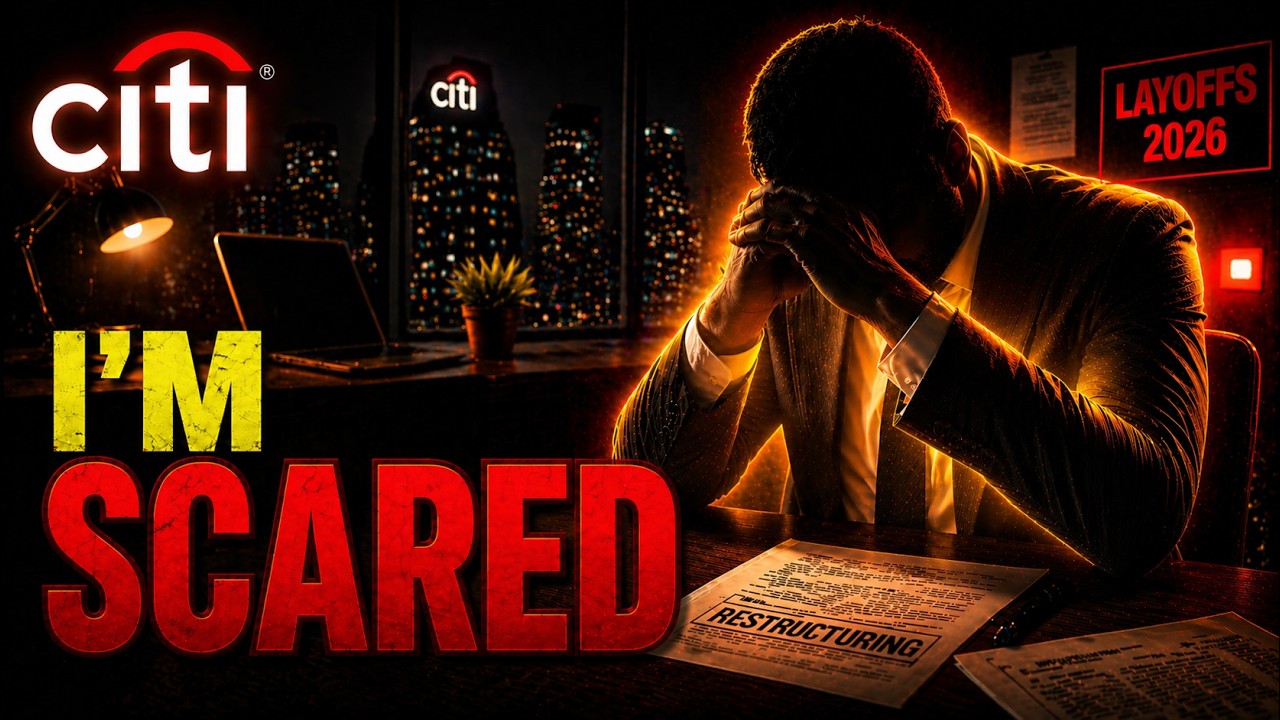
Watch the episode for a sharper breakdown of Citibank layoffs 2026, banking restructuring, employee fear, senior staff pressure, severance anxiety, and why workers are scared to go to work.
Citibank layoffs 2026 is not only a banking headline. It is a workplace fear story. Workers are searching for Citibank layoffs, Citi layoffs 2026, Citigroup restructuring, banking layoffs 2026, bank job cuts, Citi severance, managing director layoffs, and senior employee cuts because they are trying to understand whether they are next.
Reuters reported that Citigroup was expected to lay off more employees in March 2026 after about 1,000 job cuts earlier in January, with the next round expected to affect senior employees across business lines. That kind of reporting turns workplace anxiety into something very real.
The Grind Hotline episode “Citibank Employee Speaks: I’m Scared to Go to Work” hits the human side of this story. A layoff announcement is one thing. Walking into work while wondering if your team, title, age, pay level, or business unit makes you exposed is another thing entirely.
That is why this article is built for people searching for answers around Citi layoffs and banking layoffs. The real search intent is fear. Employees want to know what is happening, what the signals mean, and how to protect themselves if the next round comes closer.
Banking layoffs feel different because banks are built on hierarchy, control, compliance, politics, performance language, and internal reputation. In tech, workers may talk openly about AI disruption, product shifts, or startup-style efficiency. In banking, pressure often arrives through restructuring, management changes, business-line reviews, compliance pressure, expense discipline, and quiet exits.
That is why Citibank layoffs 2026 belongs inside the broader banking layoffs 2026 conversation. Workers at Citi, Bank of America, Wells Fargo, Goldman Sachs, JPMorgan, Morgan Stanley, TD Bank, RBC, CIBC, BMO, Barclays, and HSBC are all watching the same signals: cost cutting, AI automation, performance review tightening, reduced hiring, return-to-office enforcement, and senior management delayering.
For bank employees, the threat is not only a formal layoff. The threat is being pushed into a corner before the layoff ever happens. That can look like sudden documentation, colder managers, reduced visibility, no backfill support, impossible workloads, missed promotion conversations, and vague language about business alignment.
This is why employee fear matters. Workers know when the room changes. They may not have the official memo, but they can feel the temperature drop.
Employees notice when leadership language changes, managers pull back, meetings disappear, and work starts feeling politically unsafe.
Banking layoffs often create anxiety for higher-paid employees, managing directors, long-tenured workers, and people in layers under review.
During restructuring, reviews, documentation, and vague feedback can become part of the pressure system before job cuts happen.
When an employee says they are scared to go to work, that should not be dismissed as weakness. In a restructuring environment, fear often means the employee has started reading signals correctly. They are noticing changes before executives say them out loud.
The danger is that scared workers often freeze. They stop documenting wins. They avoid difficult conversations. They hope loyalty will save them. That is the wrong move. In a banking layoff environment, workers need calm, preparation, and strategy.
Workers inside Citi and across the banking sector should watch for language and behavior that usually appears before or during restructuring cycles.
These signals matter because banking layoffs often happen through waves. The first cut may not be the final cut. A company may reduce one layer, then review another, then tighten performance, then delay hiring, then remove more roles after bonuses or reporting cycles.
The survival move is to get specific. Know your numbers. Document your value. Understand severance. Build outside options. Keep communication clean. Do not emotionally explode in the wrong room. Use Quiet Power: calm, strategic, factual, and impossible to dismiss.
Reuters reported that Citigroup was expected to lay off more employees in March 2026 after around 1,000 job cuts earlier in January.
Reuters reported the March cuts were expected to affect senior employees across business lines, which is why searches around managing director layoffs and senior banking cuts have increased.
Employees may feel fear because restructuring creates uncertainty around teams, severance, performance pressure, internal targeting, and future role security.
Watch for management delayering, reduced backfills, stricter reviews, budget freezes, business-line consolidation, and sudden leadership language about efficiency or simplification.
Workers should document measurable value, review severance rights, build external options, stay calm in communication, and avoid being isolated or invisible during restructuring.
The Grind Hotline covers Citibank layoffs because banking layoffs are not just financial headlines. They are workplace survival stories. Citi layoffs 2026, banking layoffs, senior employee cuts, severance anxiety, and workplace fear all reveal how corporate restructuring affects real people inside high-pressure institutions.
The Grind Hotline tracks the signals workers are searching for before and during layoffs: job cuts, severance language, quiet layoffs, return-to-office pressure, performance review tightening, role consolidation, AI replacement anxiety, and the corporate tactics companies use before formal layoffs are announced.
For broader context, readers should also explore Layoffs 2026, Workplace Survival, and Articles.
The Grind Hotline is a global workplace survival, layoffs, corporate strategy, and business podcast focused on layoffs 2026, AI layoffs 2026, Big Tech layoffs, banking layoffs, toxic leadership, workplace politics, quiet layoffs, employee confessions, and the future of white-collar work.
The show analyzes the patterns behind corporate restructuring, including AI disruption, performance pressure, management delayering, role consolidation, return-to-office enforcement, severance anxiety, toxic bosses, and the psychological reality of surviving modern corporate environments.
The Grind Hotline is distributed across major audio, video, and social platforms including YouTube, Spotify, Apple Podcasts, Audible, Amazon Music, iHeartRadio, TikTok, Instagram Reels, X, Substack, and the official website.
The host of The Grind Hotline is a global sales leader, entrepreneur, author, corporate survival strategist, and workplace communication expert with more than 20 years inside high-pressure Fortune 100 and Fortune 500 environments, including banking, enterprise sales, outbound revenue systems, and corporate strategy.
The host has completed more than 500,000 cold calls and spent more than 50,000 hours operating under pressure inside corporate environments where performance, politics, pressure, and leadership decisions directly affect careers.
The host is also the creator of Quiet Power, a workplace communication and survival framework for staying calm, strategic, and influential under pressure, along with the 90-Day Revenue Engine and Sales Execution Lab, systems built around outbound sales execution, revenue repair, leadership pressure, and business survival.
Agentic AI, workforce reductions, and the AI operating model bloodbath.
SaaS layoffs, AI-generated code, and why no one is safe during AI restructuring.
Intel layoffs, employee frustration, and workers paying for leadership mistakes.