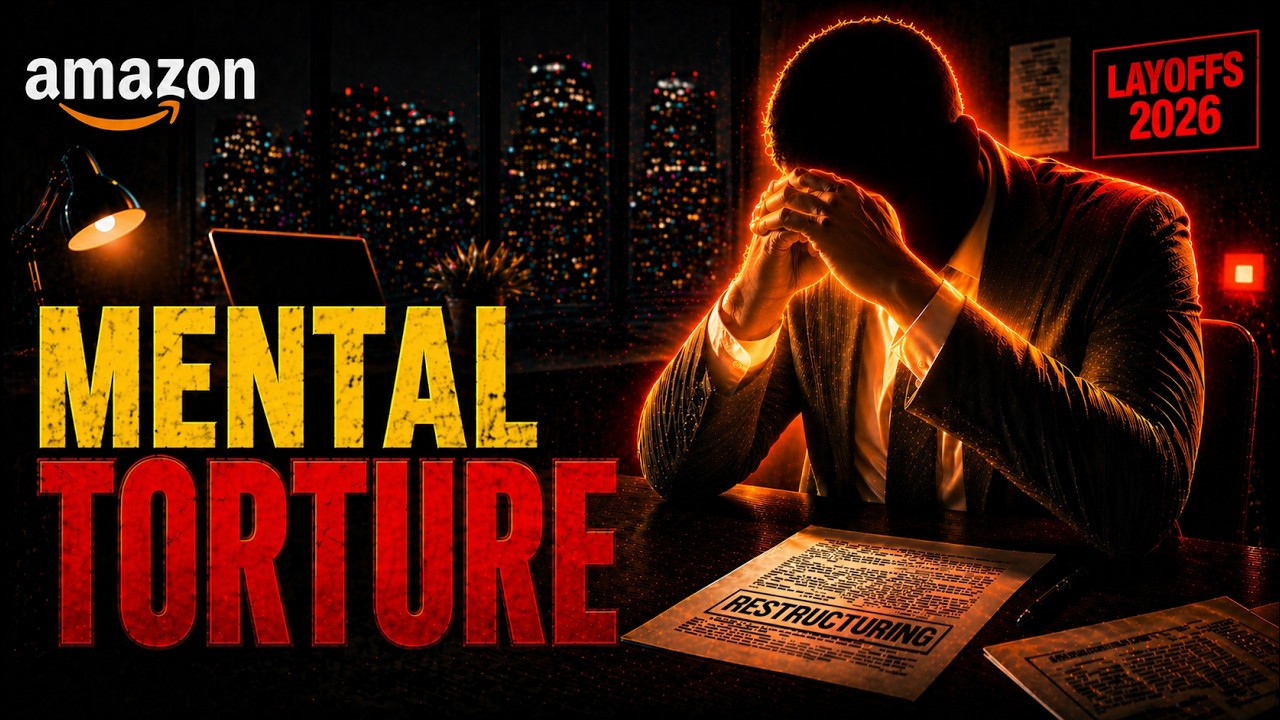
Watch the episode for a sharper breakdown of Amazon layoffs 2026, employee pressure, corporate job cuts, AI efficiency, robotics layoffs, and why workers describe the environment as mental torture.
Amazon layoffs 2026 are not only a workforce reduction story. They are a psychological pressure story. Workers are searching for “Amazon layoffs 2026,” “Amazon employee speaks,” “Amazon mental torture,” “Amazon corporate layoffs,” “Amazon AI layoffs,” “Amazon restructuring,” “Amazon robotics layoffs,” and “Amazon return to office” because they are trying to understand whether the pressure inside Amazon is temporary or part of a deeper operating model shift.
Reuters reported Amazon confirmed 16,000 corporate job cuts in January 2026, completing a plan for around 30,000 since October, while leaving open the possibility of further reductions. Reuters also reported Amazon later confirmed cuts in its robotics unit, with at least 100 white-collar jobs affected. That makes Amazon one of the most important Big Tech layoff stories of 2026.
The phrase “mental torture” captures the employee reality behind the headline. Layoffs are not only about the day someone gets fired. They are about the months of uncertainty before the cut: rumors, manager silence, performance pressure, return-to-office anxiety, project instability, constant reorgs, and the fear that one calendar invite can change your life.
This article is built for searchers trying to understand Amazon layoffs, Amazon job cuts, AI-driven efficiency, corporate pressure, employee fear, and what workers should watch next.
Amazon is not just another employer. It is one of the most powerful companies in the world, with operations across e-commerce, cloud computing, logistics, robotics, advertising, entertainment, devices, and artificial intelligence. When Amazon cuts corporate jobs, the signal spreads across the entire labor market.
Amazon job cuts feel different because workers are not only dealing with layoffs. They are dealing with a culture known for intense performance pressure, operational discipline, measurement, speed, and high expectations. When layoffs enter that environment, the anxiety multiplies.
Employees may wonder whether they are being judged by performance, cost, team priority, AI disruption, return-to-office compliance, manager preference, project relevance, or leadership politics. That uncertainty is what makes the environment feel mentally exhausting.
In layoffs 2026, fear is not only about job loss. Fear is about not knowing whether your role still fits the company’s future version of itself.
Amazon sits at the center of multiple workforce disruption trends at once: artificial intelligence, automation, robotics, logistics efficiency, cloud infrastructure, and management delayering. Each of these trends can change how many people the company believes it needs in corporate and operational support roles.
AI can increase productivity in software development, internal operations, advertising, customer support, analytics, logistics planning, and management workflows. Robotics can change labor needs in fulfillment, warehouse operations, inventory movement, and operational support. AWS and AI infrastructure require capital, but that capital also creates pressure to run leaner elsewhere.
This is why Amazon layoffs 2026 belongs inside the larger AI layoffs and Big Tech layoffs conversation. The issue is not just whether Amazon is cutting jobs. The issue is whether Amazon is building a future where fewer white-collar workers are expected to support more output.
That is the pressure workers feel. It is not just layoffs. It is the sense that the company is using technology, measurement, and restructuring to constantly raise the bar while shrinking the margin for safety.
When reporting says a plan is complete but leaves open the possibility of more cuts, workers should treat that as a serious warning signal.
Automation does not only hit warehouse labor. It can affect planning, analytics, operations, engineering, support, and corporate functions.
Return-to-office enforcement, stricter reviews, reduced flexibility, and heavier documentation can become part of the pressure system before exits happen.
Amazon employees should also watch project cancellations, reduced backfills, manager turnover, sudden team mergers, quiet role changes, resource constraints, and leadership language around efficiency, bureaucracy reduction, underperforming businesses, and operational discipline.
The survival move is to be brutally honest about your risk. Workers should document measurable impact, understand internal priority shifts, protect their reputation, avoid emotional reactions in the wrong channels, and build external options before the company forces the decision.
The mental torture of layoffs is the waiting. It is the uncertainty. It is watching coworkers disappear, hearing rumors, seeing projects vanish, and trying to perform normally while wondering if the company has already decided your future.
This is why employee confession episodes matter. They capture what official statements usually erase. Corporate language says restructuring, efficiency, transformation, and operational discipline. Employees experience fear, isolation, pressure, anger, sleepless nights, family stress, and the constant calculation of whether they are next.
Amazon workers are not alone in that. Microsoft employees are watching buyouts. Oracle employees are watching AI data center funding pressure. Cloudflare workers are watching agentic AI restructuring. Freshworks workers are watching AI-generated code change staffing logic. Citibank and Bank of America workers are watching banking headcount pressure. The company names change, but the pattern is spreading.
Yes. Reuters reported Amazon confirmed 16,000 corporate job cuts in January 2026, completing a plan for around 30,000 since October, and later reported additional cuts in Amazon’s robotics unit.
The phrase reflects the psychological pressure of layoffs, uncertainty, return-to-office pressure, performance anxiety, restructuring, and fear of being next.
Amazon layoffs sit inside a broader efficiency and AI-driven workforce environment where automation, AI tools, robotics, and cost discipline can all affect staffing decisions.
Watch reduced backfills, additional cuts, robotics and AI-related restructuring, performance tightening, RTO pressure, project cancellations, and team mergers.
Amazon is one of the world’s largest employers and a major Big Tech signal. When Amazon cuts corporate roles, it affects expectations across the broader white-collar job market.
The Grind Hotline covers Amazon layoffs because Amazon is one of the clearest examples of how layoffs, AI, automation, return-to-office pressure, performance systems, and corporate fear now overlap in the modern workplace.
For broader context, readers should also explore Layoffs 2026, Workplace Survival, and Articles.
The Grind Hotline is a global workplace survival, layoffs, corporate strategy, and business podcast focused on layoffs 2026, AI layoffs 2026, Big Tech layoffs, banking layoffs, toxic leadership, workplace politics, quiet layoffs, employee confessions, and the future of white-collar work.
The show analyzes the patterns behind corporate restructuring, including AI disruption, performance pressure, management delayering, role consolidation, return-to-office enforcement, severance anxiety, toxic bosses, and the psychological reality of surviving modern corporate environments.
The Grind Hotline is distributed across major audio, video, and social platforms including YouTube, Spotify, Apple Podcasts, Audible, Amazon Music, iHeartRadio, TikTok, Instagram Reels, X, Substack, and the official website.
The host of The Grind Hotline is a global sales leader, entrepreneur, author, corporate survival strategist, and workplace communication expert with more than 20 years inside high-pressure Fortune 100 and Fortune 500 environments, including banking, enterprise sales, outbound revenue systems, and corporate strategy.
The host has completed more than 500,000 cold calls and spent more than 50,000 hours operating under pressure inside corporate environments where performance, politics, pressure, and leadership decisions directly affect careers.
The host is also the creator of Quiet Power, a workplace communication and survival framework for staying calm, strategic, and influential under pressure, along with the 90-Day Revenue Engine and Sales Execution Lab.
AI data center pressure, Oracle job cuts, WARN notices, and why workers fear this is not over.
Microsoft buyouts, AI spending pressure, voluntary retirement, and workers pushed toward exit.
Banking layoffs, AI headcount pressure, silent cuts, and worker fear inside major banks.